Free shipping $75+ · S–XXL in stock · Wholesale blanks available

Oatmeal and natural tones: styling undyed blanks

Natural and oatmeal blanks aren’t “off-white” — they’re a design choice. Warm, vintage, and print-friendly when you lean into the tone.

Color pairing

Ink black, forest green, and rust brown all sit well on oatmeal fleece. Avoid cool greys that fight the warm base.

Brand use

Great for coffee shop merch, studio uniforms, and lifestyle brands that want softness over high contrast.
Shop natural & oatmeal

Screen print mesh counts for blank tees and fleece

Mesh count is how you control ink deposit on different blank surfaces.

Tees

156–230 mesh for spot colors on midweight jersey. 305+ for halftones and simulated process.

Fleece

Lower mesh (110–156) for opaque base on hoodies — fleece absorbs more ink. Flash between layers on dark garments.

Test pulls

Always pull a test on the actual blank SKU. V1 Blend black fleece and black jersey accept ink differently.

DTG on midweight cotton: placement and pretreat basics

Midweight jersey is the most forgiving DTG substrate — if you control moisture, pressure, and cure.

Pretreat

Match pretreat to your machine and ink set. Over-pretreat causes hand-feel issues; under-pretreat causes wash fade.

Placement

Use collar seam as Y reference. Our essential tee collar seam sits at a consistent offset from shoulder — use it instead of eyeballing center.

Cure

Follow your ink vendor spec. Garment temperature matters more than dwell time alone.

Black blank depth: reactive dye vs pigment

Not all black blanks are the same black. Understanding dye method saves you from mismatched bulk orders.

Reactive dye

Dye bonds with cotton fiber — deep color, soft hand, some crocking risk on first wash. Our essential and heavyweight black tees use reactive black.

Pigment

Sits on fiber surface — can feel slightly chalkier but very stable for some print workflows. We use pigment black on select fleece where surface consistency matters for puff and foil.

Shop black blanks

How we measure fit consistency across S–XXL

Grading isn’t just scaling — it’s maintaining shoulder slope, sleeve pitch, and body length ratios so XXL doesn’t feel like a different garment.

Our process

We grade from a base block with fixed increment rules per size. Each production run is sampled at S, M, XL, and XXL before bulk cut approval.

What to watch

Neck opening stretch, sleeve length vs body length, and hem width on fleece. Those three drive most customer fit complaints on blanks.

Hoodie vs crew: picking the right fleece blank

Both are fleece. They serve different production and retail roles.

Hoodie

Higher perceived value, larger print real estate on front and back, drawcord and kangaroo pocket add construction cost. Best for streetwear and outdoor-adjacent brands.

Crew

Cleaner silhouette, easier fold and ship, strong collar for neck label branding. Best for minimalist lines and corporate merch that needs a polished look without hood bulk.

Shop fleece

Building a wholesale blank program from zero

New print shop or emerging brand? You don’t need forty SKUs on day one. You need a tight core that reorders cleanly.

Starter kit

  • Essential tee — white + black (S–XXL)
  • Midweight hoodie — black + heather grey
  • Crew — black

Reorder discipline

Log your lot numbers. When a client reorders, match the blank SKU and size curve exactly — fit drift is how you lose repeat business.

Wholesale Blanks

Garment care for blank cotton: what to tell your customers

Your customer blames the print when the shirt fades — but wash habit kills more blanks than bad ink. Pass this care card along with every order.

The short version

Cold wash, inside out, hang dry. No bleach. Ever.

Why inside out

Friction from zippers and other garments is the main enemy of printed surfaces. Inside-out washing reduces abrasion on the decoration.

First wash

Expect minimal lint and color bleed on first cold wash for deep blacks — that’s normal for reactive dye. Separate darks for the first cycle.

Care: Wash cold, inside out. Hang dry or tumble low. Skip bleach. Follow the care label on each garment for longest life.

Full care guide

Essential vs heavyweight tee: which blank should you stock?

Two tee bodies, two use cases. The essential midweight is your daily print workhorse; the heavyweight is your structured, premium-feel blank.

Essential (180gsm)

Soft hand, lighter drape, lower price point. Best for event tees, merch drops, and high-volume runs where hand-feel matters but weight is secondary.

Heavyweight (240gsm)

Boxier, thicker, vintage-adjacent body. Best for streetwear lines, boutique blanks, and customers who judge a tee by weight first.

Our recommendation

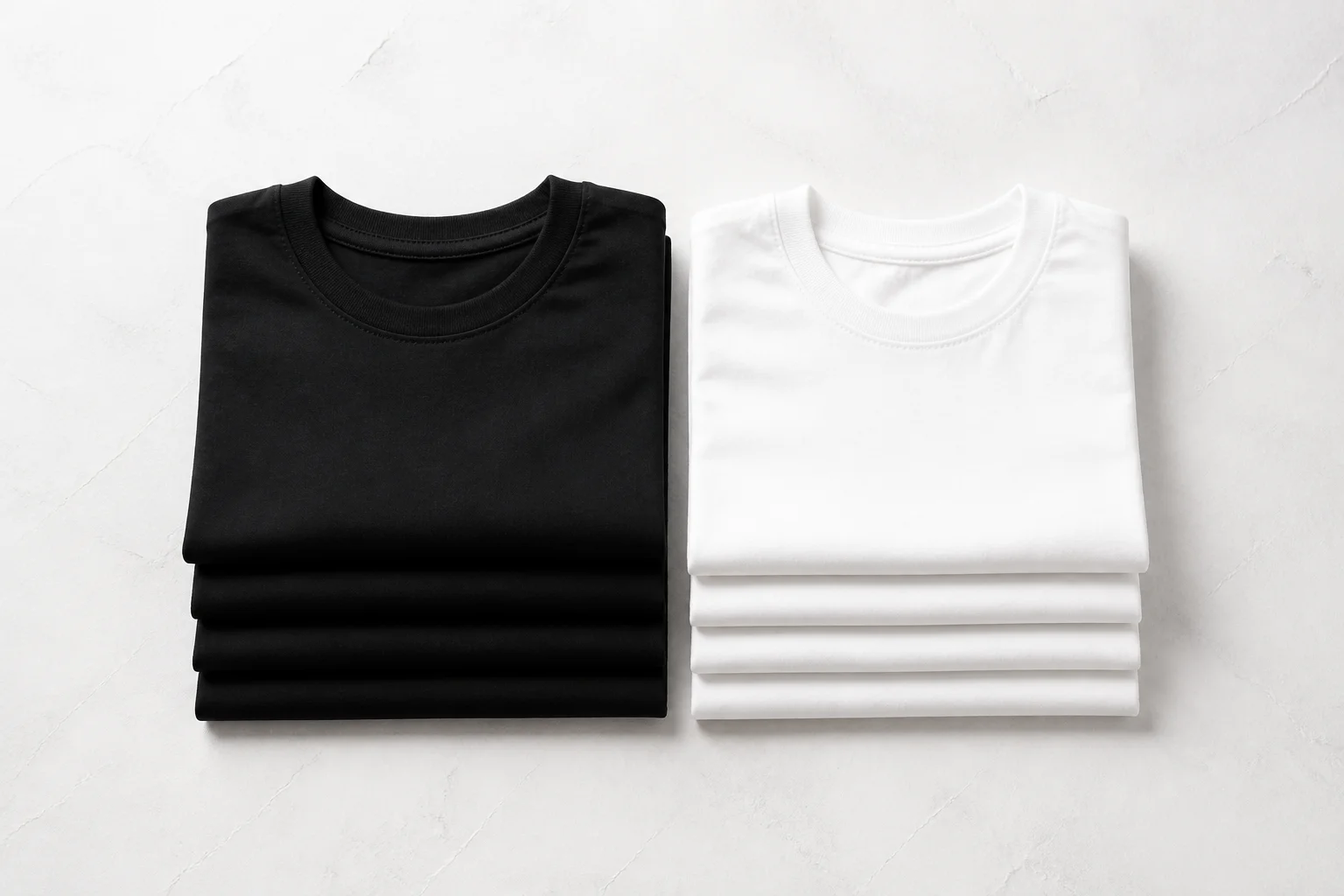
Stock both in black and white. Run your decoration tests on each — ink saturation and cure times differ.

Shop tees

Why blank quality matters before the first print

A bad blank doesn’t fail on the rack — it fails under flash, on the press, or after the customer’s first wash. Here’s what we spec before a V1 Blend SKU goes live.

Fabric face

DTG needs a smooth, stable surface. Screen print needs even tension. Embroidery needs a collar that won’t torque. We test each fabric lot for nap, speckle, and shrink before we assign a SKU.

Construction

Skewed side seams ruin center chest placement. We measure shoulder slope and body tube consistency across sizes — not just on size M.

Color

Reactive black should read black under production lighting, not charcoal-navy. White should not blue-shift under LED. We hold dye lots to a delta threshold between batches.

Shop Blanks